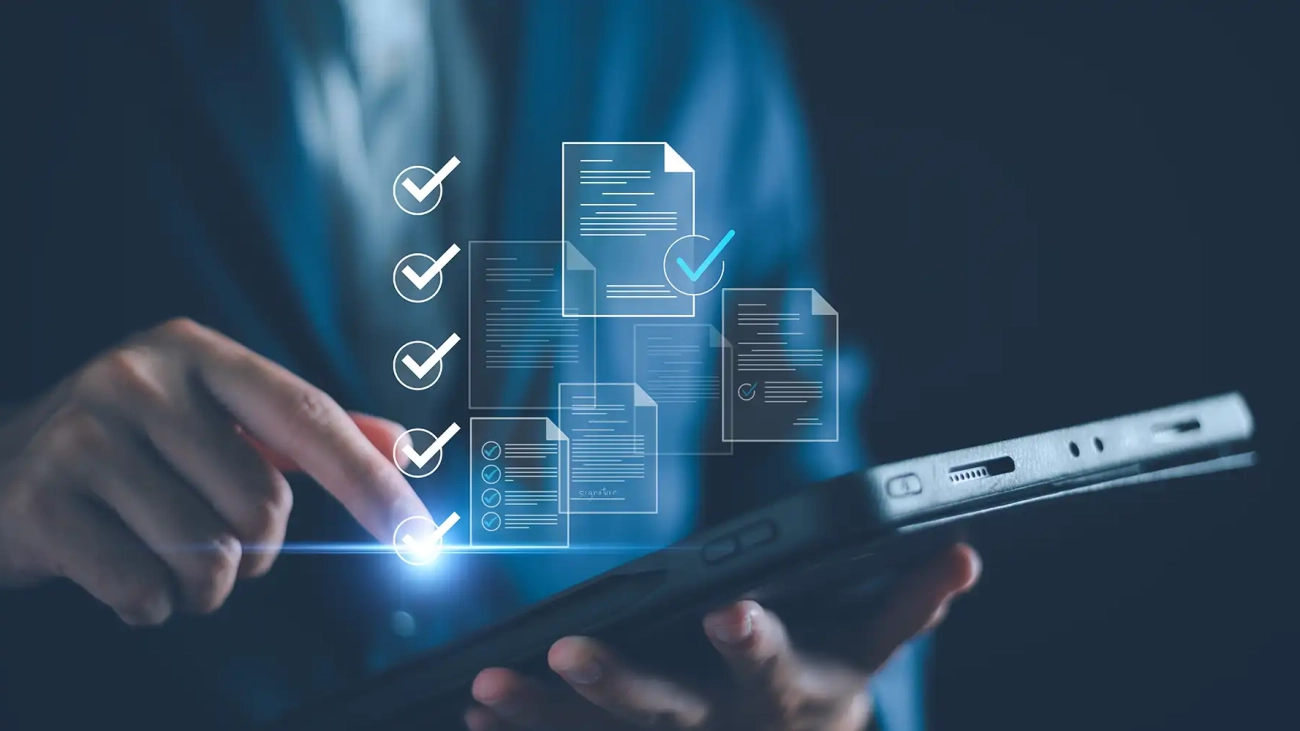
CTIC-BlogPost-Checklist

OpenAI Opens You To A Less-Stress Holiday Season

Every year, it’s certain someone will have to run out for a missed ingredient when the batter is half mixed and entree half cooked.

With so many recipes readying for the table and getting fixed up for family, friends, and neighbors, it’s too easy to leave an ingredient off the grocery trip list.

To avoid an eleventh-hour store visit during your holiday gathering – and the chaos that will inevitably greet you when you arrive to the grocery store holiday hassle – use ChatGPT to generate a list that don’t miss a thing.

  1. Simply, ask ChatGPT to “create a grocery list for me that will have all the ingredients in these recipes.”
  2. Copy and paste recipe ingredients from an online recipe or transcribe them from a cookbook. Enter the recipe ingredients as they are presented, with their specified amounts (eg 1/4 teaspoon, 1/2 large yellow onion).
  3. Likely, ChatGPT will create grocery lists each time you submit a recipe. To get have them combined into one, once you’ve shared all the recipes you’d like, ask ChatGPT to “combine these shopping lists.”
  4. Then, you’ll see a combined grocery list of the recipes you shared. The one I got generated was even sorted by grocery store section! Grab, and go to the store confidently, knowing it didn’t miss a thing.

Some other useful ChatGPT prompts to prepare your mind and meaningful moments at a holiday gathering:

  • What are some activities I can have planned or presented to keep ages 8-80 entertained while I cook?
  • We want to eat dinner at 5:30. When should I begin cooking to have a full Thanksgiving dinner ready?
    • You could add to this prompt by sharing recipes or the layout of what is available in the kitchen.
  • What could I say to excuse myself from the gathering when I need a minute to myself?
  • What are some Thanksgiving alcoholic and non-alcoholic beverages I should offer?
  • What’s something unique I can cook for a Thanksgiving gathering?

What else will you ask ChatGPT for this year?

CTIC-BlogPost-Comment

Maryland Digital Equity Plan

OSB has released the Maryland State Digital Equity Plan- DRAFT, and is requesting comments emailed through December 2, 2023.

The Baltimore Digital Equity Coalition (BDEC) has created an awesome share spreadsheet OSB- Public Comment Collection Spreadsheet where you can enter comments and see the comments of others by section of the plan.

Key portions of the Maryland Digital Equity Plan:

Pg 1-5 Section 1.1 and 1.2: Digital Equity Principles and Barriers (see also Table 1 – covered populations – the state is going to organizing funding around reaching these groups)

Pg. 6-10 Section 1.5: Implementation Plan

Pg 16-18 Section 2.3.1: Strategies for overcoming barriers

Pg 18-30  Section 2.2.3: Objections and performance indicators.  NOTE:  OSB has listed statewide percentages for each metric, but not provided any baseline numbers to the total improvements in each area, no breakdown by county, and are using data sources that aren’t very granular.  And for almost all categories, the plan says the state has a very small digital equity problem.

Pg 32-44 Section 3.1.3:  Chart of existing digital equity assets (i.e., programs and organizations) by covered population – if you provide digital equity services, make sure you are in here

Pg 48-54 Section 3.1.3: Chart of digital equity programs (if you run a large digital equity program, make sure you are in here)

Pg 63-76 Section 3.2: Chart listing the obstacles by covered population to achieving: broadband availability, broadband adoption, digital skills, online security, and device adoption.

Pg 69 Section 3.2.1 Covered Populations:  The state seems to be stating that they couldn’t find reliable sources of data for Individuals with Language Barriers and Individuals Who Have Low Levels of Literacy, so they aren’t going to speculate.  But it’s not clear whether in the charts that follow, the State is capturing the digital equity gap for these populations.

Pg 78-98 Please skim these charts.  There are people with skills in statistical analysis who will be weighing in on the Plan.  But look at the tables – in most cases the Plan is stating there is 20% gap or less between the covered populations and the rest of the state, i.e., that where 95% of the state has a specific type of digital service/device, 70% to 80% of covered populations have that same service. For example, see Table 33 on page 97 states the percentage of people have a computer or desktop by covered area:

  • 92% of higher income compared to 65.7% of lower income people -26.3% differential)
  • 89.7% of White compared to 85% of minorities (-4.7% differential)
  • 89.1% of people without disabilities compared to 73.7% of people with disabilities (15.4% differential)
  • 87.8% for people with English proficiency and 81.2% for English learners (-6.6% differential)

If, in your experience, the groups you serve do not have access to digital equity services and devices at these levels, the State needs to hear from you.

Also, compare the above data with Table 35, 36, and 37 on pages 154-158.  These tables provide a breakdown of the number of computers by household by income, race/ethnicity, and at-risk status.

Pg 171 Table 41: Confidence using the internet by household income.  There is a similar chart by age on pg 180, but no corresponding charts by race/ethnicity, language barriers, or education level.


Join us for the MDEC Listening session with the State and provide that feedback.  If you have time, make comments in the shared spreadsheet provided by BDEC as well. Click here to join the MDEC or share with others.

Title

Who are your digital navigators?

Where are we going? And, who is taking us there?

We announced Jack and Diana joining the CTIC Team – two digital navigators with the American Connection Corps. What does a digital navigator do, you might be wondering? A digital navigator is a trusted guide who plays a crucial role in assisting community members in internet adoption and the use of computing devices, building relationships with partners and organizations and emphasizing the strengths of the community in the process.

Jack and Diana are here to help community members acquire affordable internet access, obtain suitable devices, and develop digital skills and intentional relationships with technology – digital inclusion work. Well-versed with digital equity resources, they empower individuals to leverage technology towards their ambitions.

Our digital navigators will be working on an asset map with digital inclusion resources in Carroll County. This asset map will include the digital inclusion programs the Carroll Technology and Innovation Council is developing, along with the work of our partners. Any organization can be orient their work towards digital equity as resource access and online collaboration can progress many goals.

On a typical day, our digital navigators can work on a variety of tasks including

  • Planning or delivering instruction at a Senior Planet event
    • In partnership with the University of Maryland Extension, we work in collaboration with Senior Planet to deliver workshops, lectures, and courses that progress the unique goals and ambitions of participants.
    • Senior Planet programs are designed around five impact areas: financial security, social engagement, creative expression, health and wellness, and civic participation. These areas represent opportunities in the lives of older adults where technology can have a transformative effect. In essence, the programming invites participants to learn through technology – instead of just having them learn technology for its own merit and without relevant applications integrated into the instruction.
  • Communicating with a Veteran as part of the Veterans Transition to Technology program
    • The Veterans Transition to Technology programming is designed to assist in digital equity and inclusion efforts in Maryland by addressing the challenges our veterans face when seeking work and support. We provide them with the technology, training, and partnership needed to successfully navigate an increasingly digital world.
  • Attending a digital equity training session
  • Researching a blog or building digital equity resources
  • Creating or attending device distribution events
  • Planning community action days

Digital Navigators are vital in our community to keep all community members connected. Connect with Diana at diana@carrolltechcouncil.org or jack@carrolltechcouncil.org today!


Word Bank:

Digital equity is when all individuals and communities have the information technology capacity needed for full participation in our society.

The digital divide is what prevents interactions among and between communities and prevents participation and opportunity in all areas of life.

Digital inclusion refers to the intentional activities and investments that work to reduce and eliminate historical, institutional, and structural barriers to access and use of technology for all individuals and communities.

Welcome-Jack-and-Diana-to-the-CTIC-Team-1

Welcoming Jack and Diana to CTIC

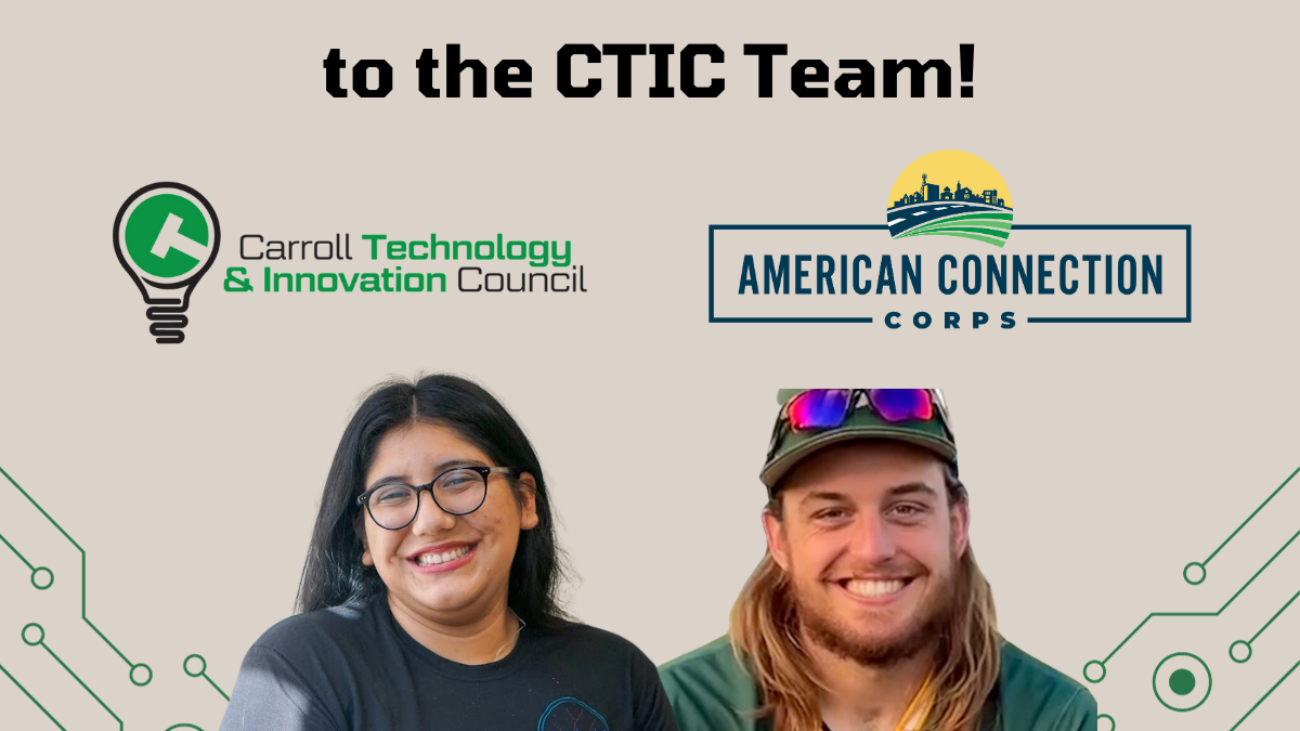
The Carroll Technology and Innovation Council is excited to welcome to the team two American Connection Corps fellows, Jack and Diana!

Lead For America and the American Connection Project have teamed up to mobilize leaders to coordinate broadband development and digital inclusion through the American Connection Corps (ACC). This national service program is focused on bridging the digital divide, locally and across the nation.

Jack Bayne studied at McDaniel College and graduated with a bachelor’s degree in 2022. Before joining us at CTIC, he worked for the National Park Service at Fort McHenry National Monument and Historic Shrine with the Chesapeake Conservation Corps. “I am super excited to start giving back to a community that gave me so much in my time here at McDaniel.”

Some fast and fun facts on Jack:

  • He played baseball at McDaniel, and currently is an assistant coach at his alma mater.
  • He has 3 dogs.
  • He has been to over 30 National Parks.

Diana is an executive board member of the Maryland Youth Advisory Council and is currently studying business management at Carroll Community College. She is also the founder and executive director of ConectandoUs, a local nonprofit serving the Hispanic community in Carroll County.

Some fast and fun facts on Diana:

  • Diana has been to 26 states in the U.S.
  • She loves puzzles and the aquarium.
  • She has an Australian Shepherd.
Untitled-design-2

What to expect from Ignite Carroll 11

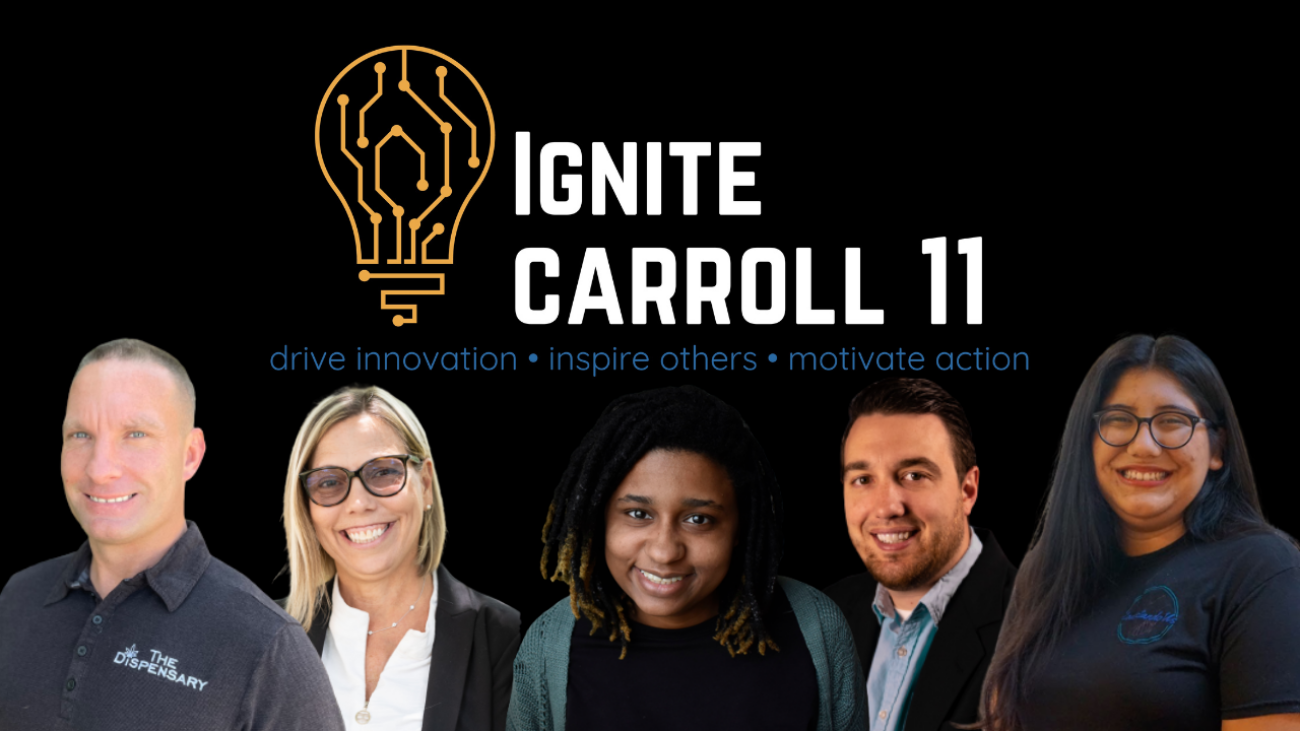
On October 18, 2023, ten speakers will take to the Ignite Carroll stage to traverse topics of cannabis, communicating affection, imaginary friends, foods fit for a president, and beyond. The speakers are people we know already – or will feel like we do by the end of the night. The best part is, every Talk is 5 minutes long – it’s efficient, it’s high-energy, and it’s all happening right downtown at the Carroll Arts Center.

“Ignite is an opportunity for people in our community to hear many different perspectives in one place, in a short amount of time,” said Chris Abell who is organizing Ignite Carroll 11 and has presented in the past. The Ignite concept puts multiple speakers in front of an audience, giving them 5 minutes apiece to enlighten the crowd. “It allows for people to come together or start a conversation about topics they didn’t know they were interested in.” 

“Anyone can give an Ignite Talk,” said Firen Forrest, Ignite Talks President. Speakers on this year’s Ignite stage of varying levels of experience – some have taken on the stage for years, others have experience from separate speaking engagements, and some are facing their fear of speaking in front of a crowd right there on the Ignite stage. But they share two things: a burning idea and the guts to get on stage and share it with the crowd. What they talk about and how they do it is up to them.

“Getting up on stage and sharing yourself with your community is what Ignite Talks is all about—being vulnerable, sharing your passion, your insight, what motivates you or intrigues you,” said Forrest. 

What can I expect as an audience member? 

For each presentation, in 5 minutes, speakers will tell their story over the course of 20 slide presentations that auto-advances every 15 seconds. These constraints breed creativity for the presenter and, Forrest mentioned, sometimes creates “wacky situations” as the speaker tries to speed up or slow down to keep in time with the slides.  

The talks are short and punchy, and they’re often presented in a way that makes you think about the subject in a new way—an “aha” moment or an angle you weren’t anticipating,” said Forrest. 

The style of the evening moves at a quick and compelling clip and the bite size presentations allow the Ignite audience to hear from over a dozen presenters on one fun, fast paced night.  

“If you find a talk boring or just not your thing, you know it’s only going to be 5 minutes until something fresh and new comes along” added Forrest. 

Why should you attend? 

“A night of Ignite Talks rallies a community and gives that community a forum to know each other more deeply, to connect, and inspire each other,” said Forrest. 

The energy of an Ignite night is uniquely invigorating. Audience members have described the evening being electric and entertaining – an event they look forward to time and time again. Every year and every speaker is different, so you’re bound to learn and see something new, even if you have attended before.

You may also walk away with the motivation and inspiration to step onto the Ignite stage yourself next time.

This year will also feature a Firecracker Networking session, inspired by the format of Ignite Talks. You’ll have an opportunity to inspire yourself and others by answering some questions we provide during the intermission.

Where can you see an evening of Ignite Talks? 

Passionate people are building up and taking to Ignite stages across the world from Sydney, Australia to Accra, Ghana – and our own Carroll County, Maryland on October 18, 2023. 

The Carroll Arts Center doors will be opening on this high-energy evening at 5:30 pm and the action will be taking place from 6 pm to 8 pm. This year will once again be hosted by the brilliant and energetic Vince Buscemi. 

Get your tickets today and follow @carrolltechcouncil on Instagram to see speakers spotlighted in the weeks leading up to Ignite Carroll.

Copy-of-Customizable-Main-Graphic-—-DIW2023-1

Celebrating Digital Inclusion Week 2023

Why is DIW Important? 

Digital Inclusion Week is October 2-6, 2023 – the eighth annual week of awareness, recognition, and celebration. With support from National Digital Inclusion Alliance (NDIA), hundreds of companies, organizations, and individuals across the country participated in special events and campaigns to promote and increase digital equity in their communities.  

With the growth of the digital inclusion field and abundance of community excitement, 2023 will be a record-breaking year for Digital Inclusion Week. Organizations, advocates, and other digital inclusion supporters across the country used DIW to highlight solutions for affordable internet access, appropriate devices for all, and digital skills programs.  

Why pay attention to DIW now?

At its core, digital inclusion is about creating a society where every individual can fully participate in the digital world. It is a journey toward equality, access, empowerment, and a brighter future.

It’s also about acknowledging the hundreds of households in Maryland who do not have a foundational tool for internet connectivity – a wireline high-speed internet subscription for their home. It will take engaging in the statewide broadband planning process, creating partnerships focused digital inclusion and network deployment, increasing public awareness of internet service affordability programs, and equipping users everywhere with digital skills.

There has never been a more important time to work together on this issue. We hope your exposure to Digital Inclusion Week this year was an opportunity to explore digital equity and contribute your expertise and energy to organizations in your community working to bridge the digital divide.

What does Carroll Tech do to uphold the DIW values?  

Across Carroll County, CTIC is working to close the digital divide and make technology available to everyone. Through programs like Techworks, for years, the CTIC has been provided the devices necessary to operate in a world becoming technologically centric. Sometimes compared to water, having quality supply and access to internet is essential to full participation in all sectors of life (dive into the digital equity impact). By engaging in national initiatives like the Affordable Connectivity Program and continuing to provide veterans with laptops, the CTIC will equip people with the connections they need to get online with confidence in their skills and their internet connection. 

Making this technology available is just the first step. The CTIC will continue to provide job training and pathways to certification and workshops empowering community members how to use and apply these devices to their ambitions and interest. Through programs like Senior Planet, the CTIC is offering solutions to the digital divide.  

Thank you for participating in Digital Inclusion Week with us! We’re excited to share with you what we worked on this week and year soon. Happy DIW 2023!

This blog was written in part by Jack Bayne, our new American Connection Corps Fellow and Digital Navigator. Digital Navigators are individuals who address the whole digital inclusion process: home connectivity, devices, digital skills, helpline, connections with community members through repeated interactions. He will be pivotal in delivering our Digital Programming. 

Digital-Inclusion-Week-2023-title-Twitter-size

Diving Into Digital Equity: Digital Inclusion Week 2023

In Carroll County, MD and beyond, a gap persists between those who have affordable access to technology, digital skills, and support to engage online – and those who do not. This disparity is referred to as the digital divide. As our world becomes increasingly digital, reliable access to technology becomes as essential to connection as roads and forms of transportation. Technology access is how we get people to where things are happening – it’s being able to use ticketing applications to go to a sporting event, confidently being able to use person-to-person payment to send money to family internationally, having a personal device to take a certification test for the job you want or the ability to stream the movie that makes you feel something special. The digital divide prevents interactions among and between communities and prevents participation and opportunity in all areas of life. 

We envision a world where economic development is supported by digital skills and technology access; where people can participate in their communities; where individuals can secure and contribute meaningful information. This is digital equity, when all individuals and communities have the information technology capacity needed for full participation in our society.   

How will this happen? Well, that’s where the work comes in: digital inclusion. This refers to the activities necessary to ensure communities have access to and use of Information and Communication Technologies (ICTs). This includes: 

  • Affordable, robust broadband internet service; 
  • Internet-enabled devices that meet the needs of the user; 
  • Access to digital literacy training; 
  • Quality technical support; 
  • Applications and online content designed to enable and encourage self-sufficiency, participation, and collaboration.  

The Carroll Technology and Innovation Council is supporting a digitally equitable and prosperous future with programs including the Veterans Transition to Tech program, offering of Senior Planet courses, and device distribution events.

The Veterans Transition to Technology programming is designed to assist in digital equity and inclusion efforts in Maryland by addressing the challenges our veterans face when seeking work and support. With this program, the CTIC provides software and hardware at no cost, workforce training through our partnerships, and digital literacy through our online platform. The success of this program and veterans in the work force begins with hardware.  

The Senior Planet programs we deliver are designed around five impact areas: financial security, social engagement, creative expression, health and wellness, and civic participation. These areas represent opportunities in the lives of older adults where technology can have a transformative effect. In essence, the programming invites participants to learn through technology – instead of just having them learn technology for its own merit and without relevant applications integrated into the instruction.

We have put devices in the hands of hundreds of individuals throughout the state of Maryland, and we will continue to create more opportunities for our communities to access technology – stay tuned!

Want to know how digital equity will improve the work your organization is doing? Email molly@carrolltechcouncil.org to find out, and to learn how we can collaborate to support your organization’s work. 

CTIC-BlogPost-HumanToRobot

My friend, the robot

“Birds of a feather flock together.” 

The proverb plays out true for a lot of us. We attract – or hope to attract – people like us. This plausibility of our social inclination to surround ourselves with beings like us is referred to as the similarity-attraction hypothesis. I say beings… because it also seems include robots.  

We often describe people by – and identify ourselves with – personality. This is the basis for how we understand who we are, and how we understand who others are. Inherently, this is knowingness is done through the lens and expression brought about by being in relationship with others. 

Personalities are sets of distinctive characteristics among humans and exchanged between them. Goldberg indicates the personality is composed of openness, conscientiousness, agreeableness, extraversion, and neuroticism – you might have heard these referred to these factors as the “Big Five.” Levels of extroversion are particularly exposed in defining a human’s personality as it characterizes it is often associated with one’s social aptitude in various relationships. An extroverted person is generally energized by external stimulus, while an introverted person will be comparatively less socialable. It follows that it is often the case introverted people tend to have fewer relationships than extroverted counterparts as they present with less engagement in social interactions. 

Of our perceptive abilities in social interactions, verbal and non-verbal communication deliver information, emotion, and intention to us. Verbal communication delivers purposes and details; non-verbal communication supports delivery by conveying information subtly with gestures, facial movements, and eye movements. In application to levels of extroversion, it’s notable that extroverted people more actively form social relationships with facial communication, while introverted people are less likely to do so.  

Studies indicate that social rules and terminations of human-human interactions will equally apply to human-robot ones, and similar rules to engagement – aka, the prevalence of personality in building relationships – apply. “If computers and robots are able to communicate with humans, humans will respond to these computers and robots using the same elements of social interactions that they employ in human-human interactions.”

A purpose-blinded study, participants interacted with robots programmed to introverted or extroverted properties (eg passive facial movements, slow facial expressions, and small, infrequent eye contact movements for an introverted robot). The responses of participants were measured by indexes of anthropomorphism, friendliness, preference, and social presence. The results of participants’ perception of the robots were correlated directly with their personality type. Extroverted participants found a higher degree of anthropomorphism, friendliness, and social presence than intermediate or introverted participants when interacting with a robot holding extroverted properties. When introverted participants interacted with the robot similar to them, they felt higher degrees of friendliness, immersive tendency, and preference. Breaking the correlation, introverted participants did find a lower degree of presence with the introverted robot.  

In similar studies, subjects are found preferring a computer acting similar to themselves and reporting higher satisfaction with their interactions. “Birds of a feather flock together,” even if no one has feathers, one is covered in skin, and the other runs on batteries. 


 Check these out:

Park E, Jin D, del Pobil AP (2012) The Law of Attraction in Human-Robot Interaction. International Journal of Advanced Robotic Systems 9(2).  

Nass C, Steuer J, Tauber E, Reeder H (1993) Anthropomorphism, agency and ethopoeia: Computers as social actor. Proceedings of the INTERACT ’93 and CHI ’93 Conference Companion on Human Factors in Computing Systems. New York: ACM. pp. 111–112. 

Nass C, Moon Y, Fogg BJ, Reeves B, Dryer C (1995) Can computer personalities be human personalities? International Journal of Human-Computer Studies 43: 223–239. 

CTIC-BlogPost-Speech

Great delivery for great ideas

We all have great ideas. But an idea can only become as great as its delivery.

You once in a while come across those speakers that grab your attention and hold it. They articulate their thoughts as though they have masterfully rehearsed a script, and deliver stories as though you are living through it with them. It’s magic.

You too have probably experienced those moments where each of your words feels perfectly placed – the world seems to open up before you as you find your flow and your ideas find receptive ears.

Whether you are readying to capture that feeling for an upcoming engagement, or would like to nourish that ability to tap into when you need it next, we’ve got some ideas for how to make your idea delivery great.

Listening like a Speaker.

There’s a practice prolific writers take part in – they read like writers. They look out for literary devices and tactics authors employ to deliver the content. They pick out punctuation, sink into sentences structures, and rake out rhyme schemes – and alliteration. From this investigation of words in newspapers and cereal boxes, readers that read like writers gain a better understanding of language and its functions and pick up tips, tricks, and templates along the way to try out in their own work. A speaker can do the same.

Listen to people talk online and in your day-to-day life to learn about speaking. Pay attention to what everyone is doing with their words – purposeful and not. Make mental notes of what engages you and what diminishes your focus, what language choices garner your trust or move you to be dismissive, what makes them see knowledgeable or inexperienced. Listen like a speaker. Listen for the good and the bad and seek to learn from it all. Recognize every interaction as an opportunity. Remember, even if you’ve learned what not to do, you’ve learned something!

Quick Tips to Kick Start Your Observations

Here are some observations of speaker tactics. Use this format and process as a model for how you listen. Pay attention to speaker choices and then name the outcomes on listeners. Then, transform this observed interaction into a tip you can act on.

  • Get your audience speaking and responding to you. Have the person engage with you is a sure way to grab their attention. Seek responses and create opportunities for them to interact with you and your content.
  • Provoke responsiveness and engagement with humor or a question at the beginning of you speaking. Get their buy-in during the first minute by inviting them to participate in the energetic exchange.
  • Denote your thinking process. Share how you are traveling through the ideas entering your head or how stories are connecting themselves in your mind. This offers the listener sort of a roadmap for the discussion and makes them feel like they understand you – and ultimately your thinking and ideas – more.

Prime Practice Advice

Tips on process are powerful for creating sustainable outcomes. Seek process advice from aware or experienced speakers by talking to one or finding content on YouTube or in a podcast. Check out these tips you can have in your back pocket for preparing or course correcting a delivery.

  • Demonstrate your understanding of the presentation content. Review key points or details you don’t want to miss during your drive, deliver your presentation to a friend, make bullet points and quiz yourself on remembering them. Get some good tests of knowledge under your belt so you can be assured you know what you’re talking about, even if you experience some nerves before the moment of action.
  • Practice in front of a mirror and pay attention to how your facial expressions sync up with words.
  • Record a voice memo of yourself speaking and listen back to where your inflections lie. Dipping into a lower register at the end of your sentence often instills more trustworthiness, but there may be occasions where you want to jump up in your voice to build intrigue or collaboration.
  • Try slowing down your rate of speaking. Slowing down is often a tip we get moments before the presentation, but it can be hard to do when you haven’t practiced doing so. Vary your speed when speaking to give yourself an arsenal of options to pull from when you are presenting, particularly if you are working with time constraints in a conference or stage setting.

Have your own advice? Give us a tip! We learn by sharing, doing, and – of course – practicing.

CTIC-BlogPost-Ignite

Am I right for Ignite?

The Ignite Carroll season is upon us for the eleventh time. The unique concept of the Ignite talk gives speakers 5 minutes to deliver a presentation of 20 slides that auto advance every 15 seconds. It’s an endeavor that challenges speakers new and experienced, pushing ideas into a format that distills them to their most pertinent and powerful parts.

This is the second year I’ll be helping to organize it; it’s the first I’ll be applying to present. I write this to “speak” it into action because, in truth, I still sit slightly dissuaded from taking the stage, wondering:

Is this opportunity right for me? Is this the right time? Do I have something worth saying? Will people want to hear it?

I can hurl myself into answering these questions for days, weeks, months… there are few limits to the creativity of thought, especially when it pertains to how I, and others, will define me and my choices. But the most important part to answering them comes at the very end, when the answer begs the next question: “…And?”

And, what will I decided to do next, in spite of or because of this information? And, what if I still have one good reason to do it? And, what if I will learn some unrealized lesson from this, one I haven’t imagined yet? And, does this reason really matter?

Some of the biggest “and…” extensions come right from Ignite. The Ignite concept is meant for people to share something they are passionate about. The beauty of this simplicity is, everyone has at least one passion – the idea that hums throughout your life or fires you up, the project you pursue every week, the concept that you persistently explore. The Ignite stage is the platform to share these perspectives and experiences. So, if you can follow up your excuse with:

  • And, I care deeply about this
  • And, I believe someone should hear this
  • And, my community needs to know about this

then, Ignite is right for you – and maybe for me, too.

Diana Flores, founder of ConectandUs, felt the call to present and took the Ignite stage for the first time at 18 years old. “Honestly, for me it just felt like I needed to do it because I wanted people to know they aren’t alone in their struggles but also to start the conversation in a meaningful way.”

Although the call appears clear, Flores was not without her own internal battle, “Being vulnerable in that way was a such a difficult step to take but there was just something inside me telling me that someone out there needed to hear my story so that they could know that they weren’t alone.”

Like with most hard things, there’s a million reasons to not do it. But there is one solid reason to do it: because you can. If you have an idea and a desire, it might be your time to apply to Ignite.

After submitting your idea and being accepted into the cohort of Ignite Carroll 11 speakers, there will be many opportunities to receive coaching on your Ignite presentation and guidance from past Ignite speakers. Although you will be taking the stage solo, you will never be alone. There is an Ignite community behind the stage and in the audience to support you, as well as Ignite headquarters and your Ignite talk coaches in the wings.

Will you Ignite the night?