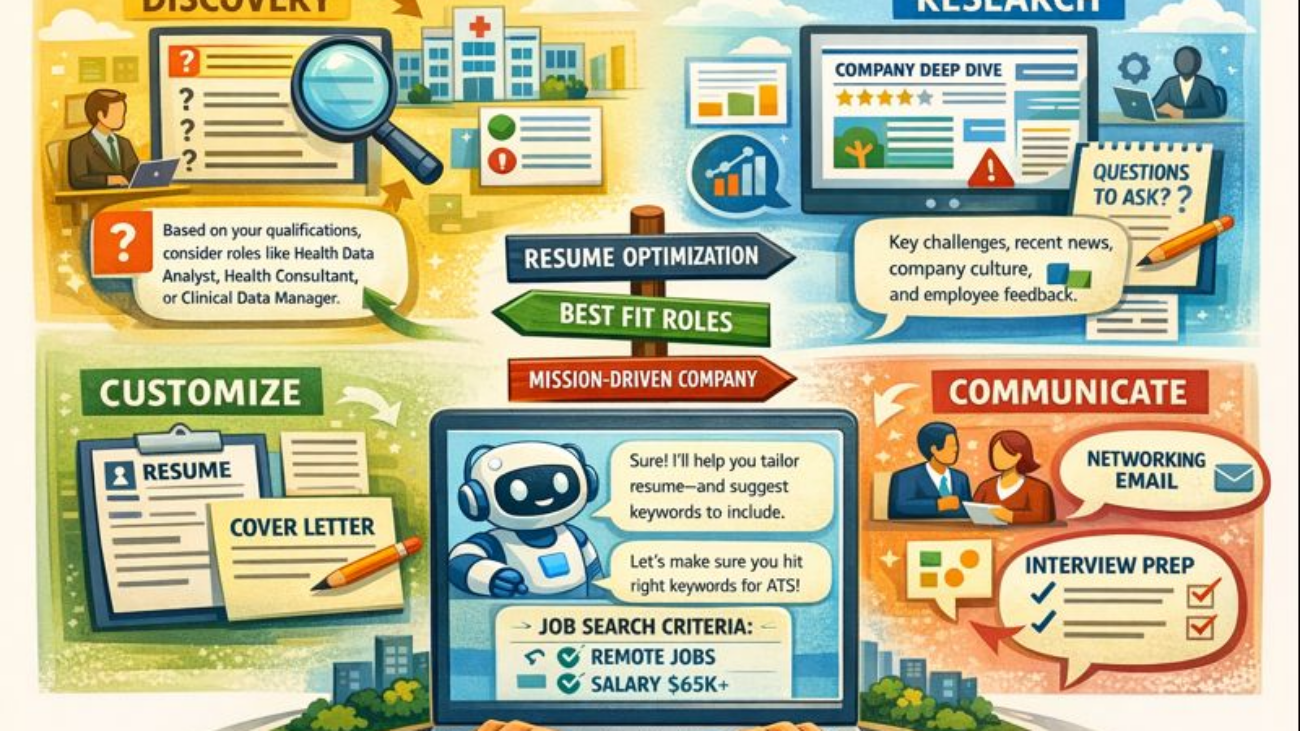
1. DISCOVERY: Find Jobs You Didn’t Know Existed
Expand Your Search Vocabulary
What to Provide:
- What you’re interested in (topics, industries, types of work)
- Positions that have appealed to you
Prompt Template:
I'm interested in [healthcare and data analysis]. Some positions that have
appealed to me are [Clinical Research Coordinator, Public Health Analyst].
What are other positions that have similar responsibilities or would align
with these interests?
What to Provide:
- Your current qualifications (education, experience, skills)
Prompt Template:
Here are my qualifications:
- Education: [Bachelor's in Psychology]
- Experience: [3 years in customer service, 1 year coordinating volunteer programs]
- Skills: [Excel, project coordination, empathetic communication]

What roles am I best suited for? Please suggest 10-15 job titles I should search for.
Smart Filtering: Find Companies That Match YOUR Needs
What to Provide:
- Non-negotiables (must-haves)
- Strong preferences (very important)
- Nice-to-haves (flexible)
Prompt Template:
Help me find companies and open positions that match these criteria:

NON-NEGOTIABLES:
- Remote or hybrid (max 2 days/week in office)
- Salary: $65,000 minimum
- Located in [Maryland/DC area] or fully remote

STRONG PREFERENCES:
- Generous PTO (15+ days)
- Professional development budget
- Health insurance with low deductible

NICE-TO-HAVES:
- Flexible hours
- 401k match
- Mission-driven organization

Please find companies that meet these requirements and list any current
open positions that match my background in [your field/experience].
2. RESEARCH: Know Before You Apply
Company Deep Dive
What to Provide:
- Company name
- What you want to know
Prompt Template:
I'm considering applying to [Company Name]. Please help me research:

1. What's the company culture actually like? (Synthesize Glassdoor reviews,
   employee feedback, news)
2. What challenges or changes has the company faced recently?
3. What are their main initiatives or priorities right now?
4. Any red flags I should be aware of?
5. What do employees say they value most about working there?

Please provide sources for your information.
Industry Landscape
What to Provide:
- Role or field you’re targeting
Prompt Template:
I'm targeting [marketing coordinator] roles. Help me understand:

1. What skills are increasingly required in these positions?
2. What's the typical salary range in [your location]?
3. What are emerging trends in this field I should know about?
4. How is AI changing this type of work?
3. CUSTOMIZE: Tailor Applications Without Starting from Scratch
Resume Optimization
What to Provide:
- Job description (copy/paste)
- Your current resume or relevant experience
Prompt Template:
Here's a job description I'm applying for:
[PASTE FULL JOB DESCRIPTION]

Here's my current resume/experience:
[PASTE YOUR RESUME]

Please help me:
1. Identify gaps between what they're looking for and what I have
2. Suggest which of my experiences to emphasize most
3. Rewrite 3-5 of my bullet points to better match their language
   and requirements
4. Highlight any keywords I should include for ATS systems
Cover Letter Generator
What to Provide:
- Job description
- Your relevant experience
- Why you’re interested (genuine reasons)
Prompt Template:
I'm applying for [Job Title] at [Company Name].

Job description:
[PASTE JOB DESCRIPTION]

My relevant experience:
[BRIEF SUMMARY - 3-5 key points]

Why I'm interested:
[GENUINE REASONS - their mission, recent project, growth opportunity, etc.]

Please write a compelling cover letter that:
1. References specific aspects of the company or role
2. Highlights my most relevant experiences
3. Sounds professional but authentic (not overly formal)
4. Is about 3 paragraphs (keep it concise)
4. COMMUNICATE: Professional Messaging Made Easy
Networking Email
What to Provide:
- Person’s name and role
- How you found them (LinkedIn, alumni network, referral)
- What you want (informational interview, advice, introduction)
Prompt Template:
I want to reach out to [Name], who is a [their role] at [Company].
I found them through [LinkedIn/alumni database/mutual connection].

My goal: [Learn about their career path / Ask about opportunities at their
company / Get advice on breaking into this field]

My background (briefly): [1-2 sentences]

Please write a networking email that:
- Is respectful of their time (under 100 words)
- Makes a specific, easy-to-answer request
- Sounds genuine and not generic
- Includes a clear call-to-action
Follow-Up After No Response
What to Provide:
- Context of original message
- How long it’s been
Prompt Template:
I sent [a job application / a networking email / an interview follow-up]
to [Company/Person] [2 weeks ago]. I haven't heard back.

Please write a polite follow-up message that:
- Reiterates my interest
- Doesn't sound desperate or annoying
- Provides an easy out if they're not interested
- Is brief (3-4 sentences max)
Thank You Email After Interview
What to Provide:
- Interviewer’s name
- Key topics discussed
- Specific details you remember
Prompt Template:
I just interviewed with [Name] for [Position] at [Company].

Key discussion points:
- [We talked about their new initiative in X]
- [I shared my experience with Y]
- [They mentioned challenge with Z]

Please write a thank you email that:
- References specific conversation points
- Reiterates my interest and fit
- Adds any relevant information I forgot to mention
- Sounds warm and professional
- Ends with clear next steps
5. LINKEDIN: Optimize Your Professional Presence
Headline Transformer
What to Provide:
- Current job title or status
- Key skills or interests
- What makes you unique
Prompt Template:
Current headline: [Project Coordinator]

Additional info:
- Key skills: [stakeholder management, process improvement, event planning]
- Proud of: [launched 3 successful community programs]
- Looking for: [nonprofit program management roles]

Please create 5 compelling LinkedIn headlines that:
- Are specific and attention-grabbing
- Include searchable keywords
- Show value, not just title
- Are 120 characters or less
Profile Summary (About Section)
What to Provide:
- Your professional story (career journey)
- What you’re passionate about
- What you’re looking for
Prompt Template:
Help me write my LinkedIn "About" section.

My story:
[Started in customer service, discovered I love solving problems, moved into
operations, passionate about improving systems that help people]

Key strengths:
[Process improvement, empathetic communication, cross-functional collaboration]

Currently:
[Looking for operations or program coordinator roles in mission-driven orgs]

Please write a 3-paragraph summary that:
- Tells my story in an engaging way
- Uses "I" voice (first person, conversational)
- Includes keywords for searchability
- Ends with what I'm looking for
- Sounds like a real person, not a robot
Engaging Post Ideas
What to Provide:
- Your field or industry
- Recent accomplishment, lesson learned, or observation
Prompt Template:
I want to create LinkedIn posts that showcase my expertise in [your field].

Recent experience or thought:
[I just learned X / I completed a project involving Y / I've been thinking about Z]

Please create 3 LinkedIn post ideas that:
- Are 100-150 words
- Start with a hook
- Share a genuine insight or story
- End with a question or call-to-action to encourage engagement
- Sound authentic to my voice (not overly salesy or corporate)
6. NETWORK: Generate Leads Like a Pro
Find Decision Makers
What to Provide:
- Company name
- Department or team
Prompt Template:
I'm interested in [marketing] roles at [Company Name].

Please help me:
1. Identify who the hiring manager or department head would likely be
2. Suggest where to find this person (LinkedIn, company website)
3. Find any mutual connections I might have
4. Identify recent company news or projects I could reference
Personalized Outreach
What to Provide:
- Person’s LinkedIn profile info or bio
- Your connection point (shared interest, alumni, company interest)
Prompt Template:
I want to reach out to [Name] on LinkedIn.

What I know about them:
[Current role, previous experience, recent post they made, shared school/interest]

My background:
[Brief 1-2 sentences]

My goal:
[Learn about their work / Explore opportunities at their company /
Get industry advice]

Please write a LinkedIn message that:
- References something specific about them (not generic)
- Makes a genuine connection
- Makes a small, specific request
- Is under 100 words
7. INTERVIEW PREP: Practice and Research
There are tools made especially for interview prep. These recommendations are for using free chat bot tools.
Generate Likely Interview Questions
What to Provide:
- Job description
- Company info
Prompt Template:
I have an interview for [Job Title] at [Company Name].

Job description highlights:
[Key responsibilities and requirements]

Please generate:
1. 10 behavioral questions they're likely to ask
2. 5 technical/skills-based questions
3. 3 questions about why I want this role/company

For each, suggest what they're really trying to assess.
Practice Your Answers
What to Provide:
- The question
- Your draft answer
Prompt Template:
Interview question: [Tell me about a time you led a team through conflict]

My answer:
[Your draft response]

Please give me feedback:
1. Does this follow the STAR method (Situation, Task, Action, Result)?
2. Is it too long/short?
3. What would make it stronger?
4. Rewrite it to be more compelling
Company/Interviewer Brief
What to Provide:
- Company name
- Interviewer names/titles (if known)
- Interview date
Prompt Template:
I have an interview with [Company Name] on [date].

Interviewers (if known):
- [Name, Title]
- [Name, Title]

Please create a one-page brief that includes:
1. Company overview (mission, recent news, key initiatives)
2. Background on interviewers (if I provide names)
3. Likely pain points or challenges in this role
4. 5 thoughtful questions I should ask them
5. Key points I should emphasize about my background
8. SALARY NEGOTIATION: Know Your Worth
Research Fair Compensation
What to Provide:
- Job title
- Your location
- Your experience level
Prompt Template:
I'm negotiating for a [Job Title] position in [Location].

My experience: [X years in field, relevant skills/credentials]

Please help me:
1. What's the typical salary range for this role in this area?
2. What's reasonable to ask for given my experience?
3. What other benefits should I negotiate beyond salary?
4. How should I frame my salary request?
Negotiation Email
What to Provide:
- Offer details
- Your research on fair compensation
- Your target number
Prompt Template:
I received an offer for [Position] at [Company]:
- Salary: [$X]
- [Other benefits mentioned]

My research shows the market rate is [$Y - $Z].
I'd like to request: [$Target amount]

Please write a negotiation email that:
- Expresses enthusiasm for the role
- Professionally makes my case for higher salary
- References market data
- Remains collaborative (not demanding)
- Leaves room for discussion
TIPS FOR USING THESE PROMPTS
✅ Be Specific: The more details you provide, the better the output
✅ Iterate: If the first response isn’t quite right, ask for revisions:
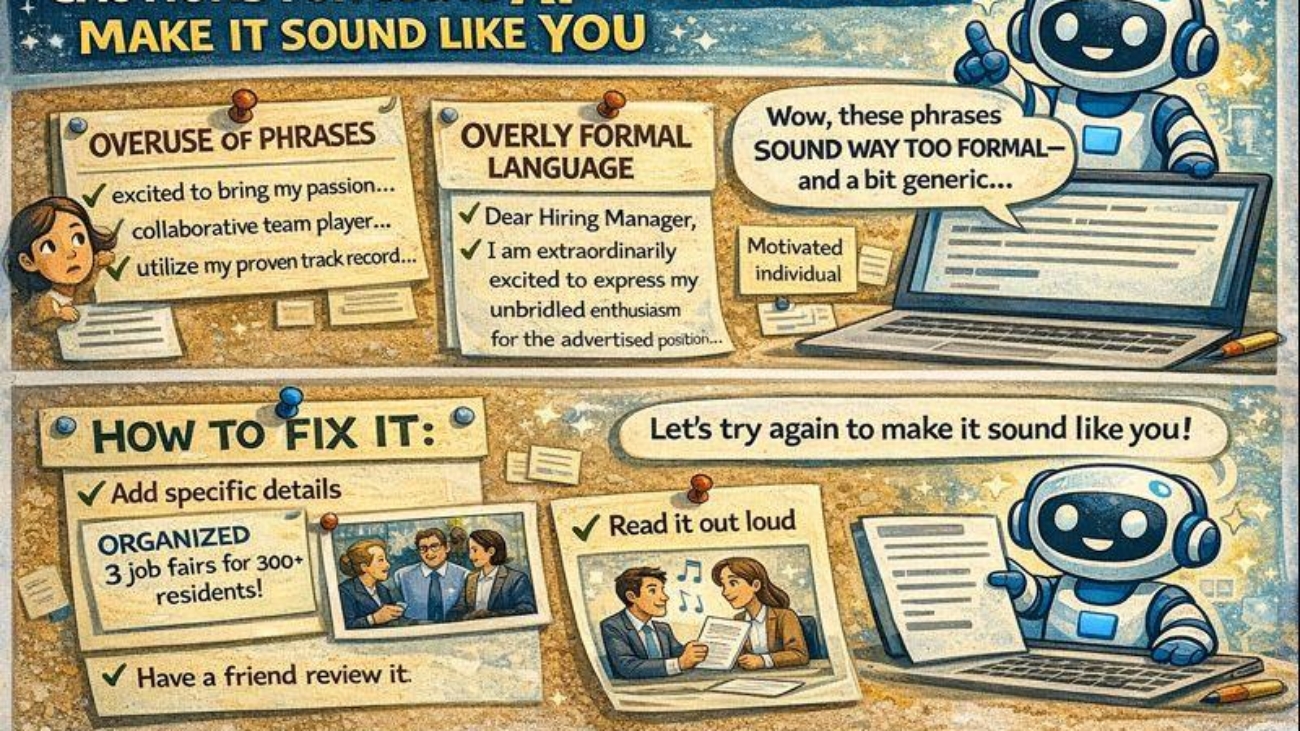
- “Make this more conversational”
- “This sounds too formal, make it warmer”
- “Focus more on X aspect”
✅ Always Personalize: AI gives you a strong draft—add your authentic voice
✅ Fact-Check: Verify any company info, salary data, or claims before using
✅ Keep It Real: Use AI to save time, not to fake who you are
RECOMMENDED TOOLS
- ChatGPT (OpenAI) – Free version works great for most prompts
- Claude (Anthropic) – Excellent for longer documents, nuanced writing
- Gemini (Google) – Good for research and connecting to live data
- Comet – can be used to conduct live research, and lead sourcing, especially when used over top of LinkedIn Premium
Remember: AI is your assistant, not your replacement. It helps you work smarter so you can focus on what really matters—building genuine connections and finding the right fit.